


“Astrotourism: The Rise of Night Sky Travel Experiences”
October 21, 2025 | by Marco Santiago
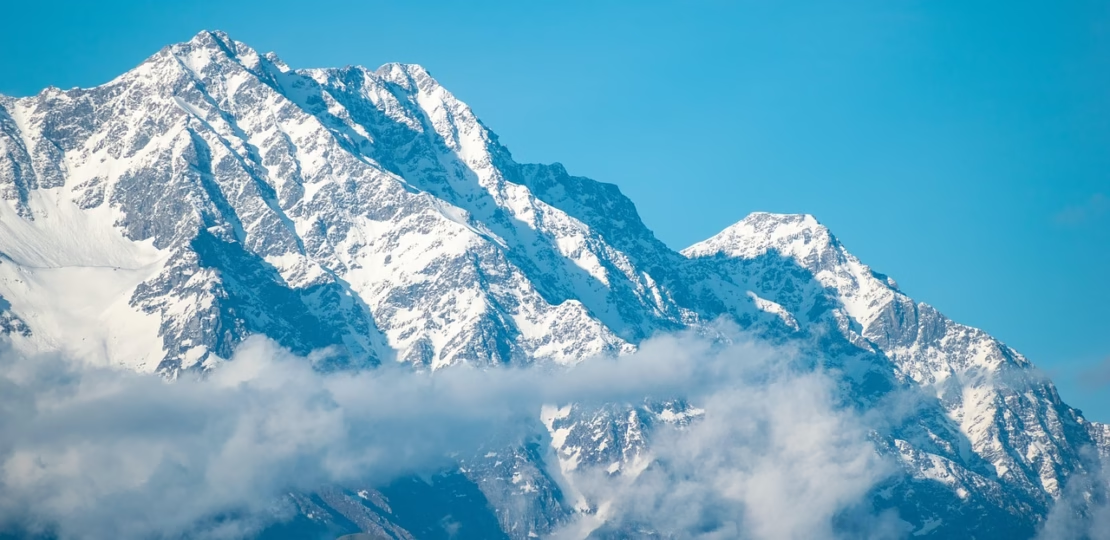
Astrotourism: The Rise of Night Sky Travel Experiences
There is a profound magic in stepping outside, away from the city’s stifling glow, and looking up to a night sky sprinkled with stars in the millions. It feels like an ancient connection rekindled—one that pulses through the veins of humankind since time immemorial. From my travels weaving through remote deserts, mountaintops, and secluded islands, I’ve found a new kind of journey taking hold—a pilgrimage not just of place, but of the cosmos itself. This is the era of astrotourism, where the night sky is the destination, and the stars, our guides.
The Quiet Revolution of Dark Skies
It’s hard to believe that in a world saturated by smartphone screens and endless city lights, there are still pockets of darkness so pure and profound they swallow the Milky Way whole. But these sanctuaries of night sky untouched by light pollution are rapidly becoming coveted escapes for travelers seeking to disconnect and reconnect—both to themselves and to the universe.
Places like New Zealand’s Aoraki Mackenzie, Chile’s Atacama Desert, and the U.S.’s Big Bend National Park have become pilgrimage sites for stargazers, astronomers, and anyone hungry for the wonder hidden in the cosmic tapestry. These sanctuaries don’t just promise celestial views; they offer immersive experiences that transform how we see the world and our place within it.
The Stories Written by Stars
During my first astrotourism experience under the vast desert skies of Tenerife, I stood with a group around a telescope, feeling both awe and humility. As the guide pointed out constellations and wove their ancient myths—stories of heroes, gods, and creatures—the night seemed to come alive with narrative. The stars weren’t just dots of light; they were storytellers, connecting cultures across time and geography.
“The cosmos is within us. We are made of star-stuff. We are a way for the universe to know itself.” – Carl Sagan
This feeling was electric. The stars invited us not just to observe but to participate in a centuries-old tradition of wonder, storytelling, and exploration. Every glimmer held a secret, every shooting star a moment of magic passing between heaven and earth.
Beyond Stargazing: Astrotourism Experiences that Stir the Soul
Astrotourism is no longer about merely pointed telescopes and scattered facts—it’s a multisensory expedition. Many destinations now offer night hikes that culminate in star-filled clearings, camping experiences on volcanic slopes where silence wraps the air like a blanket, and even gourmet dinners paired with celestial storytelling sessions. I’ve joined guided meditation under the stars, where breathing syncs with the slow dance of planets and constellations.
Technology enhances but never replaces the raw, human experience. Apps help novices find constellations, and remote observatories provide unparalleled views, yet the heart of astrotourism remains the elemental awe of nature’s cosmic masterpiece.
The Impact: Rediscovering Ourselves Through Dark Skies
Travel always changes us, but astrotourism has a unique power. It dissolves the boundaries that separate us—not just culturally or geographically, but existentially. Observing the sheer scale of the universe in an unpolluted night sky invites a profound humility and perspective on the pace and noise of daily life.
I’ve seen travelers return from these experiences quieter, more reflective, carrying back a deepened respect for nature and an inspired curiosity about the unknown. In a way, astrotourism is a bridge between science and poetry, logic and emotion, earth and cosmos.
Looking Forward: A Movement to Protect the Night
As astrotourism grows, it also brings an urgency to protect the places where the stars still reign. There is a rising global movement for dark sky preservation, advocating to shield these fragile nocturnal environments from light pollution, ensuring future generations can continue to marvel at the universe’s grandeur.
Our collective journey now includes stewardship, where travel is not just about taking in beauty, but also giving back—through mindful tourism and supporting conservation initiatives. It’s a vital chapter in this new era of exploration.
In a world filled with ceaseless noise and distraction, astrotourism is a vivid reminder of a truth we often forget: sometimes, the most profound journeys are those that take us up, beyond the earth, and back into the brilliant, timeless night.
Marco Santiago
— Cultural Explorer & Cosmic Storyteller

RELATED POSTS
View all


“Gig Tripping: Traveling Abroad to Attend Concerts and Explo
June 17, 2025 | by Marco Santiago
“Detour Destinations and Noctourism Top 2025 Travel Trends”
July 26, 2025 | by Marco Santiago

“Coolcations”: The Rise of Arctic and Northern Destinations
November 17, 2025 | by Marco Santiago