


“Vibe Coding”: The Emergence of AI-Driven Software Developme
November 17, 2025 | by Olivia Sharp
“Vibe Coding”: The Emergence of AI-Driven Software Development
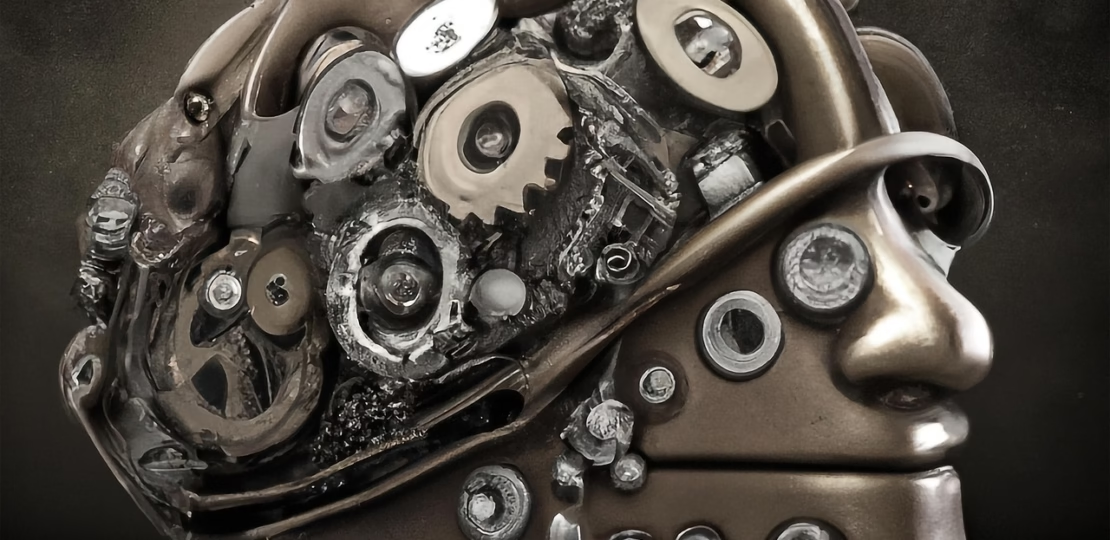
In recent years, the software development landscape has been undergoing a subtle yet profound transformation. This evolution is not just about faster computers or more powerful languages; it’s about an entirely new paradigm that reshapes how developers interact with their code — something I like to call “Vibe Coding.” It’s a concept born from the rise of AI-driven tools, fundamentally blending human intuition and creative problem-solving with machine efficiency and intelligence.
What Is Vibe Coding?
Imagine coding that flows with your thoughts — where your programming environment becomes a responsive partner rather than just a passive interface. This is at the heart of Vibe Coding. AI assistants like GitHub Copilot, OpenAI’s Codex, and other emerging tools are no longer just autocomplete helpers; they’re collaborators interpreting the “vibe” of your project, anticipating your needs, suggesting entire blocks of logic, and even offering architectural advice.
Vibe Coding reflects the synergy between human creativity and AI’s pattern recognition and code synthesis capabilities. It’s less about mechanical typing and more about intuitive software crafting. The AI adapts to your style, preferences, and context, offering an experience that feels fluid, personalized, and remarkably close to co-creating.
The Practical Shift in Developer Experience
For practitioners like myself who live in code daily, these AI-driven interactions are reshaping workflows and expanding what’s possible within developers’ daily routines. No longer are we gripped by routine syntax details or boilerplate code. The AI largely takes that off our plate, freeing creative bandwidth to focus on higher-level design, debugging nuances, and user experience challenges.
I have noticed a tangible shift—from jumping around documentation and syntax syntax references toward engaging more directly with problem-solving and innovation. The AI is effectively becoming a pair programmer that never tires, constantly learning from open codebases, pulling from best practices, and adapting instantly to new frameworks or languages.
Benefits Rooted in Real-World Application
The advantages of Vibe Coding go beyond novelty. Here are key, real-world benefits I’ve observed:
- Accelerated prototyping: When testing ideas, rapid AI suggestions speed up initial development phases, allowing quicker iteration cycles.
- Enhanced code quality: By recommending idiomatic constructs and security-conscious patterns, the AI helps prevent common pitfalls.
- Lower entry barriers: Newcomers receive contextual help that flattens the learning curve, facilitating faster onboarding onto complex projects.
- Cross-domain adaptability: AI can bridge knowledge gaps for developers delving into unfamiliar languages or domains, effectively democratizing expertise.
Ethical and Practical Challenges
However, this integration isn’t without caution. As with any powerful tool, responsible innovation is paramount. The AI relies on vast datasets reflecting collective human coding efforts, raising important questions about intellectual property and bias. Developers must remain vigilant, verifying and understanding AI-generated suggestions rather than accepting them blindly.
Furthermore, the risk of over-dependence exists. Tools should enhance—not replace—the critical thinking and creativity intrinsic to good software engineering. I advocate for cultivating a balanced “vibe” where AI and human insights complement rather than overshadow each other.
Looking Ahead: The Future of Vibe Coding
As models grow more sophisticated, the collaborative relationship between coder and AI will deepen. I envision environments where AI not only suggests or writes code but also tests, documents, and educates interactively. This will foster an ecosystem where continuous learning is embedded into everyday development.
“Technology’s greatest promise lies in amplifying human potential, and AI-driven coding embodies this ideal at its core.”
This shift will redefine productivity metrics—not just lines of code produced but the quality of creative problem-solving and innovative solutions. The human touch remains indispensable, but the expression of that touch becomes more expansive, enriched by the AI’s computational power and expansive knowledge.
Conclusion
Vibe Coding captures the emergent phenomenon where AI and developers engage as co-creators in software development. This paradigm marks a significant milestone in our journey toward more intuitive, fluid, and inventive programming experiences. While challenges around ethics and dependence must be managed thoughtfully, the transformative potential of AI-driven development tools is unmistakable. It is a space I watch closely and contribute to, driven by a vision of technology that enhances human creativity and responsibility in equal measure.
Embracing Vibe Coding means rethinking how we write, understand, and innovate with software—ushering in a future where coding is less about keystrokes and more about the shared pulse of human and machine collaboration.

RELATED POSTS
View all


“AI-Powered Edge Computing: Revolutionizing Real-Time Data P
July 30, 2025 | by Olivia Sharp

“AI-Powered ‘Ask for Me’ Service Revolutionizes Customer Int
June 11, 2025 | by Olivia Sharp

“Vibe Coding: The Future of AI-Assisted Software Development
August 15, 2025 | by Olivia Sharp