


“Vibe Coding”: Empowering Non-Programmers to Create Personal
November 2, 2025 | by Olivia Sharp
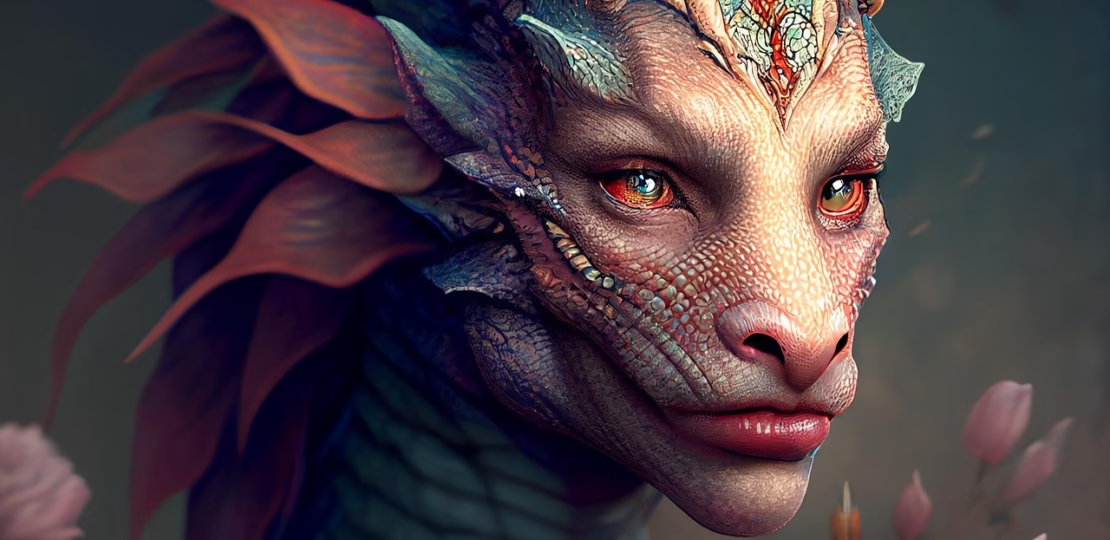
Vibe Coding: Empowering Non-Programmers to Create Personalized AI Applications
In the rapidly evolving landscape of artificial intelligence, there is an increasing ambition not just to build smarter machines but to democratize AI creation. “Vibe Coding” stands out as a promising paradigm that empowers individuals without traditional programming skills to craft personalized AI applications. This approach isn’t simply about lowering technical barriers; it’s about enabling authentic, intuitive interaction with AI tools that resonate with the user’s unique goals and context.
The Essence of Vibe Coding
The concept of Vibe Coding can be seen as an evolution from earlier low-code or no-code platforms, but it’s distinguished by its emphasis on “vibes” — a metaphor for intuitive, personalized tastes, intentions, and nuances that conventional coding languages struggle to capture. Instead of rigid, syntax-driven commands, users communicate their needs more fluidly, often through natural language prompts, visual metaphors, or modular building blocks infused with contextual intelligence.
At its core, Vibe Coding is about interpreting user intent with heightened sensitivity, enabling AI models to co-create applications that feel less like generic tools and more like extensions of an individual’s creative and functional vision.
Bridging the Gap Between Expertise and Accessibility
Traditional software development and AI programming often demand deep domain knowledge — from shaping neural network architectures to writing complex algorithms. This creates an exclusivity that leaves non-programmers sidelined, despite how much creative potential they might bring to the table. Vibe Coding platforms bridge that gap by abstracting complexities behind user-friendly interfaces tailored to human expression rather than machine precision.
Imagine a small business owner who needs an AI-driven customer support chatbot tailored specifically to their brand voice and product nuances but has no coding background. With Vibe Coding, they can articulate the tone, frequently asked questions, and style preferences directly through conversational or drag-and-drop tools. The platform understands these “vibes” and assembles an application that fits perfectly — no syntax errors, no debugging marathons.
Real-World Applications and Impact
Several emerging platforms demonstrate how Vibe Coding accelerates innovation across diverse fields:
- Creative Industries: Artists, writers, and designers employ vibe-driven AI to generate drafts, curate ideas, or co-design projects without writing code, preserving creative spontaneity.
- Healthcare: Medical professionals can prototype diagnostic assistants or patient engagement tools customized for particular workflows or patient demographics.
- Education: Educators develop personalized learning aids, converting teaching “vibes” into adaptive quiz generators or interactive tutoring systems.
In all these scenarios, the impact is clear: individuals craft relevant AI-driven experiences — rapidly, effectively, and with far greater personal ownership.
Challenges and Ethical Considerations
While Vibe Coding unlocks accessibility, it also raises important questions. The very ease of creation risks proliferating poorly constructed or biased AI applications if users lack the critical grounding in AI ethics and best practices. Responsible innovation demands that Vibe Coding tools incorporate transparent guardrails, real-time feedback mechanisms, and accessible education on ethical AI principles.
Moreover, privacy and data security become paramount as more users independently build AI solutions that may handle sensitive information. Platforms must thoughtfully balance personalization with robust protections to prevent misuse or unintended consequences.
The Road Ahead
Looking ahead, Vibe Coding will continue to evolve alongside advances in natural language understanding, contextual AI, and user experience design. These improvements will sharpen the AI’s ability to capture subtleties and anticipate user needs, making the interface between human intention and machine execution smoother than ever.
For businesses and creators, embracing Vibe Coding means cultivating a mindset shift — from passive consumption of AI towards active, meaningful participation in its design. This shift holds the promise of a more inclusive and innovative AI future where technology truly mirrors the diverse “vibes” of its users.
“Empowering non-programmers to tell AI what they envision, without translating it through code, opens new frontiers for human-tech synergy.”

RELATED POSTS
View all


“AI-Powered Edge Computing: Revolutionizing Real-Time Data P
August 9, 2025 | by Olivia Sharp

“AI Apocalypse? Why language surrounding tech is sounding in
August 29, 2025 | by Olivia Sharp
